Sunday, 19 October 2014

It's October, it's La Ciotat and it's still summer. Hura pour Le Jumelage!


Le reception committee Francais....

Bridgwater is incredibly fortunate to be twinned with the French Mediterranean  town of La Ciotat. Apart from both once having a bit of industry there’s not a right lot in common. However, this ‘jumelage’ has been in existence since 1957 so look ye not gift horses in mouths.


The La Ciotat jumelage committee sit in constant readiness for Bridgwater visitors to turn up to bestow upon them  bundles of generosity, camaraderie, friendship and hospitality. Well, not just Bridgwater visitors, they also have twin towns in Germany and Slovenia and maybe Italy, although the Mayors apparently keep getting shot there. The French support International relations in a big way and councils have a budget to support this whilst in England ‘twinning’ is a scary word, little financial backing  is provided by the councils, people ‘pay their own way’  and an increasing number of ‘little Englanders’ are voting UKIP. C’est la vie, we might say (unless we’re UKIP) (which we aren’t).

Bridgwater-La Ciotat veterans


Claire Anstee
This time La Ciotat played host to a community choir led by natural voice practitioner Claire Anstee. The 35 strong group also included none singers and some seasoned Bridgwater-La Ciotat veterans, notably Keith Giles currently the Bridgwater Twinning rep for the French link.


Flying out from Bristol to Nice at an unappealingly early 7am (which meant getting to the airport at 5am) the group landed in Cote ‘d’azur sunshine, boarded the waiting coach and were in La Ciotat by 1230.


Staying at the Hotel Croix de Malte run by Pierre and his team (largely a man from Brittany called Stefan) the travellers were inches from both beach, harbour and town centre. Some went shopping, some went into the sea and the rest went to the Calanques. That’s a range of intriguingly shaped coastal peaks and inlets which stretch from La Ciotat to nearby Cassis.  People were in the water, yes in October, in  Eagles Beak bay and wandering the sub tropical gardens of the nearby park Mugel.

Sur Les Quais


The yachting fraternity
La Ciotat was once an industrial dockyard. As that industry declined the yachting fraternity moved in and now you can’t move for yachts all along the harbour side and in the old dock. Massive yachts. Yachts so big that you could walk from one end to the other and you’d be in the Bahamas . Crews appeared to be mainly Brits (if you count Australians) (which isn’t easy given the rate of unreported boomerang incidents). The choir had a concert on the quayside in the shadow of the yachts. A nightclub called ‘Sur Les Quais’ (yes, ‘on the quays’) stepped in last minute when the planned concert at the Eden theatre was pulled because of ‘technical difficulties’ –which also extended to the planned French choir also not making it.


The Choir perform at the night club
But never mind, the singers sang and did their show on the stage of the nightclub with a big and appreciative audience, largely from the jumelage committee, but also including a few bemused matelots presumably spotting the notice ‘welcome to the Bridgwater choir’ on a sign where they expected to see ‘ce soir DJ Jean-Claud avec son eep-op’.

La Voie Douce


A rapid deployment of French singing talent saved the day from being a one sided Britfest as up stepped Jean-Marie Vandamme to sing something from Mozart and a fellow twinning worker to sing Amazing Grace. And then in stepped DJJC and the ripping sounds of the soundsystem ripped  arses from chairs and set feet a flying as the nightclub reverted to purpose with the Brits leading the way in a ‘bit of a dance’.


Taking the soft track
A new feature of La Ciotat life is ‘La Voie Douce’, literally ‘the soft track’ but actually a converted railway line. Converted into a railway line that both pedestrians and cyclists can pass along (without the trains).  Leading from very near the Croix de Malte in the centre of town  it takes people comfortably to the edge of town near la Bastide Marin, which is a small chateau within it’s own grounds that  the local council have done up . And so we took a walk up it and at the end were the French jumelage people, this time armed with bread, cheese, a paste made from olives, some rose wine, awkwardly interspersed anchovies, and some grilled sausages (for the vegetarians) (not really, they probably had anchovies).

une autre jour in Eden


Visiting the worlds 1st Cinema
On the final day the group were invited into the Eden Theatre. Right next door to the Croix De Malte. This was the first cinema in the world. The Lumiere brothers had filmed the first movie ‘train entering La Ciotat Station’ in La Ciotat and then premiered it here. The plot wasn’t up to much. Train enters station then stops. But it paved the way for the entire movie industry and numerous late night art movies on BBC 2.


Taking advantage of the constant good weather,  several people went off to nearby Cassis-obviously at one time twinned with Burnham (and Highbridge) (well, done that jumelage committee) and by the final night we invited all the French (not ALL of them obviously, that would be 67 million and the Croix De Malte can only hold 50) to a little party. Which seemed to also include some of the yachting fraternity. And inevitably turned into another opportunity to dance la nuit away.


This particular visit was so popular with the French Jumelage ctte that they decided to come over to Somerset next year so we could return the favour. But also it was important because we negotiated a restoration of the student exchange links which had been laying on the shelf for a few years. So…bon chance and ca plan pour moi!
Eagle's Beak bay along the Calanques

Monday, 6 October 2014

Bridgwater and Priverno well on the way to a Full Twinning as Mayor drops in.


Mayors Angelo and Steve on the balcony at Priverno Town Hall

Bridgwater’s link with Priverno is going from strength to strength and this week it was the turn of Mayor Steve Austen to pay his first visit to the hilltop Italian town with a small delegation  to see what projects we could bring about for the benefit of both communities.


For the past few years we have taken students from Bridgwater college, footballers from Bridgwater and our Czech win town Uherske Hradiste, and the Voice of the People choir –who will shortly be returning for their second bite at the mozzarella.


Sabaudia- a view from the breakfast table
Priverno is less than an hour south of Rome.  That’s a 5 € train journey. However, it’s also not far from the sea, so we started our expedition this time at the Hotel Oasa di Kufra in the nearby seaside town of Sabaudia  where we often accommodate touring groups who are attracted by it’s private beach access, sand dunes,  stunning lagoonside location and spectacular views across the Med. 


Every room has a sea view (apart from the few that don’t) , the sea laps almost at the beach-side terrace and the restaurant with it’s wide span of ocean facing windows provides diners with terrific sunsets.


The hilltop town of Priverno
Less than half an hour away is Priverno. To get to it you travel across the former Pontine marshes, drained in the 1930s, to present a landscape reclaimed from the sea and not too dissimilar to Sedgemoor. As the marshes reach the Appenines the landscape is dotted with fortified hilltop towns, the first of which is Priverno – formerly Privernum in Roman times and with a wealth of archaeology from that period which it displays in a town centre museum.


Mayor Steve meeting the youth of Priverno. (mainly councillors)
Mayor Angelo Delogu was there to greet us with Chairman of Council Roberto Antonini and the youngest set of town councillors you’ve seen this side of  S-Club Seven. In fact it would take 3 Piverno councillors to equal the average age of their Bridgwater counterparts.


Now,most of this trip involved one long conveyor belt of Italian food which seemed never ending, so I’ll just describe the programme in between that and if your mind starts to wander, just imagine another stream of plates of Mozarella, polenta, prosciutto, olives and artichokes  filling in the gaps.


Mr Orsini demonstrating how to choke on an olive
One thing they wanted to show us was the opportunities for economic co-operation, particularly in the field of food. The San Martino castle, where the group was staying, happened to be the venue for the ‘Slow Food’ co-operative who were promoting the precise opposite of ‘fast food’- natural, organic, full of taste and obviously best eaten in the courtyard of a Medieval castle. 


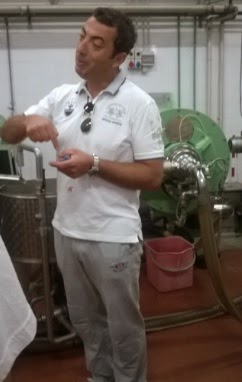
One key member of the organisation was the Orsini Olive Oil firm, based in Priverno, and very keen for us to find an outlet for their excellent quality  virgin brand and so we were taken to the factory and given an ‘oil tasting’ – first thing in the morning when your taste buds are at their best apparently. It didn’t help when Mr Orsini demonstrated the art of oil tasting by snorting the luminous green substance through various nasal orifices and nearly choking himself in the process. The olive oil smelt of cut grass and tomatoes and had won world wide awards.


Tim and Mick 'Bufala Soldiers'
Another local product was Mozarella. The famous cheese made from the milk of the Buffalo. Indian buffaloes. The wet marsh land of the area was ideal for this and so we went to the farm of (yet another insanely young)  councillor Enrica Onorati to meet the buffalo themselves and then eat them in their restaurant. 


Italian bread is a must for any dinner table, and in Priverno they make Falia, which is their own brand.  So we were invited into the Panificio Bilancia to see Mr B himself making the Falia and then handing it over to us 30 minutes later piping warm  and loaded with ham.


Sibelco-providing a big hole that brings employment
Employment is a big issue in Priverno, where the agricultural output is not matched by an equivalent in traditional industry. We saw two sides of the coin when we first visited Sibelco, a major employer , which had dug one of the largest holes in Europe in order to extract it’s silica and brought with it well paid jobs for the local economy, whilst at the nearby SAPA metalworks the behaviour of the multinational  company  there in attempting to transfer the plant to Vietnam and throw 135 families onto the streets had been met by the workers occupying the plant to stop the company asset stripping and keeping open the chance for a buyout by another company. 


Bridgwater visitors join the picket line
Striking workers were on the SAPA picket line and our delegation had no hesitation in joining them in the spirit of international solidarity in defence of their community.


The main purpose of the visit was to firm up the school to school links. Bridgwater College Italian department had offered to set up an exchange project, initially based on pen pals, then homehosting. To promote the  link the delegation was invited to the Teodosio Rossi High school where students  spoke of their keen interest to visit Bridgwater and had the chance to demonstrate their proficiency in English.

Italian students present themselves to the Mayor
Teodosio Rossi school is situated down one of Priverno's many typical narrow backstreets but once you're through the iron security gates and find a window it suddenly opens up with  spectacular views across to the not so distant hills.


Mayor Steve Austen  praised the students for their ‘bravery’ in speaking before an English speaking audience before himself demonstrating his own bravado by launching into an impromptu promotion of Bridgwater  and bigging up future links….of which MANY are planned, including the Voice of the People Choir, Bridgwater College Italian students, a senior and junior football project, a UK summer camp, economic co-operation and a support fund for the  striking workers. Bridgwater and Priverno are well on their way to a full twinning with support catered for wherever it’s needed.

Luigi introduces Cllr Smedley to Cllr Enrica on the road to buffalo central
The delegation of 7, including teachers and  councilors, had to be shovelled back onto the plane home  lest they exploded with the quantities of Italian food  bestowed on them by almost everyone they met in Priverno. A special thanks has to be said to the hard working  Luigi Teodonio (Mayor Angelo's left hand man) who translated, drove the minibus, organised the programme and even refrained from drinking for the weekend.

Wednesday, 3 September 2014

Hungary, Football and Goulash - so near and yet so far


Zsolt Nemeth greets the Bridgwater cupholders (sic)

Neville Chamberlain once described Czechoslovakia as a far away country of which we know little. Well Hungary is a bit further  on still, cross the Danube and then take a hard step to the right. Hungary’s political solutions are all somewhere in the past. The Fidesz Government of Viktor Orban is blindly chasing some Thatcherite vision of unbridled capitalism as the country teeters on the brink of becoming another Greece and the second largest party Jobbik are an unlovable bunch of uniformed Empire revivalists whose symbol is a map of Hungary expanded to include chunks of neighbouring countries. And of course there’s elections coming up.


This was pretty obvious when when our little group of about 40 Czechs and Brits turned up for an Internationalist football tournament. Every year Bridgwater International and Uherske Hradiste based stairlift manufacturers Altech do a joint trip somewhere to promote International Friendship via the medium of football. This year it was the Hungarian partner town of Sarvar.

Castle of the Bloody Countess
Clear as mud

Sarvar-translating romantically as ‘city of mud’, also was the hometown of 17th century mass murderer Elizabeth Bathory who  bathed in the blood of peasant girls to maintain her eternal youth. Today there’s a wellness spa and fitness centre. But these things seem very popular with Hungarians. That’s, er, the wellness centres I mean…


The centrepiece of Sarvar is in fact Bathory’s castle which is centrally located,in a park where the former moat would have been, and accessible by a bridge. Inside during our visit there were plenty of Hungarians in varying degrees of National folk costume ranging from leather boots and hunting garb to 19th century military chic, again largely leather and the occasional medieval man at arms in chain mail and plumed helmet. Presumably with an element of leather somewhere beneath.  Adorning the occasional medieval jerkin and Habsburg Huszar chic, a surprisingly large number of Jobbik symbols. It’s nice to have a hobby.

Goulash roasting on an open fire
The 'other Hungary'

Beyond the old city walls and through a covering  of trees  we find the other Hungary.  On the edge of the city park is an area of communist era tower blocks with a smattering of parked Ladas and Trabants amidst an array of community facilities such as children’s play grounds, sports areas and a boating lake. Again nostalgically evocative, but compared to the other philosophies on offer, decidedly more modern. 


It was here that our football tournament was held. An alliance of left leaning parties  (and it wasn’t hard to fall into this category considering how far right the 2 main parties were) had organised a festival for the more internationalist minded people of Sarvar featuring dozens of gigantic pots of goulash cooking in the open air over kindling, street entertainment for the kids plus beer and palinka made more desireable by helpings of chewy bread covered in lard.

SmedHeadGoalNet Bridgwater v Czechs
Footballing grates

But the highlight of this festival of the people was the international football. That was why we were here. A 6 a side tournament featuring 5 local teams and 2 foreign teams.


The Brits and the Czechs had already played each other the day before in Uherske Hradiste  and Bridgwater had won 4.3 in a hard fought game which turned on a penalty brought about by one of the Czech players literally standing on striker Steve Miles and putting his right foot out of action  for the rest of the weekend . Two classy goals from the Arthur Mullard of the footballing world, cllr Smedley, one bouncing in off his  glasses-less head, and a winner from Jason ‘Crouchy’ Mantyk turned the tables on the increasingly desperate Czechs.


Bridgwater (in bibs) v MSZP
The football was looking good and so it was with that air of confidence that we set off next day on the Czech coach, with a slight stopover in the Slovak capital Bratislava, to take on the Hungarians.

Sacrifice

But then things went wrong. Ah England was it ever thus. Miles’ foot had not improved, yet with teams of 6 required and with a squad of, er, 6, the brave Captain Oates  had no option but to sacrifice himself for the team. And so went in goal. Smedley went off to goal hang, but without his glasses was last seen somewhere in the vicinity of Ljubljana  and regular keeper Ian ‘Stoner’ Stone was given an unwanted outfield role, the momentum of his first fearless run at the opposition taking him not only clean through the penalty area and the goal net but across a gravel path and into a tree  before crashing down to earth on a bunch of innocent picnickers. 


Brits head for the Goulash and lard
Our first game, against the MSZP (Hungarian Socialist Party) set the tone. Despite an early Smedley goal the team went down 3.1. 


By game two the Brits had recovered some composure and playing against a local village team of mere youths we held them to a 2.2 draw. 2.0 down for much of the match , Bridgwater pulled back a goal through Jamie Reade and finally a brilliant through ball from the energetic Phil Rogers set up Crouchy to get the equaliser.


The final game came around and the opposition were all over us. Losing 4.1, and possibly distracted by their goalkeeper constantly adjusting and re-adjusting his hair style throughout the game, Bridgwater signed off.

Charitable bottom

Czechs on the sidelines
The Czechs fared even worse losing every single one of their games  despite having a squad of almost 20 to chose from and finishing a charitable bottom of the tournament.

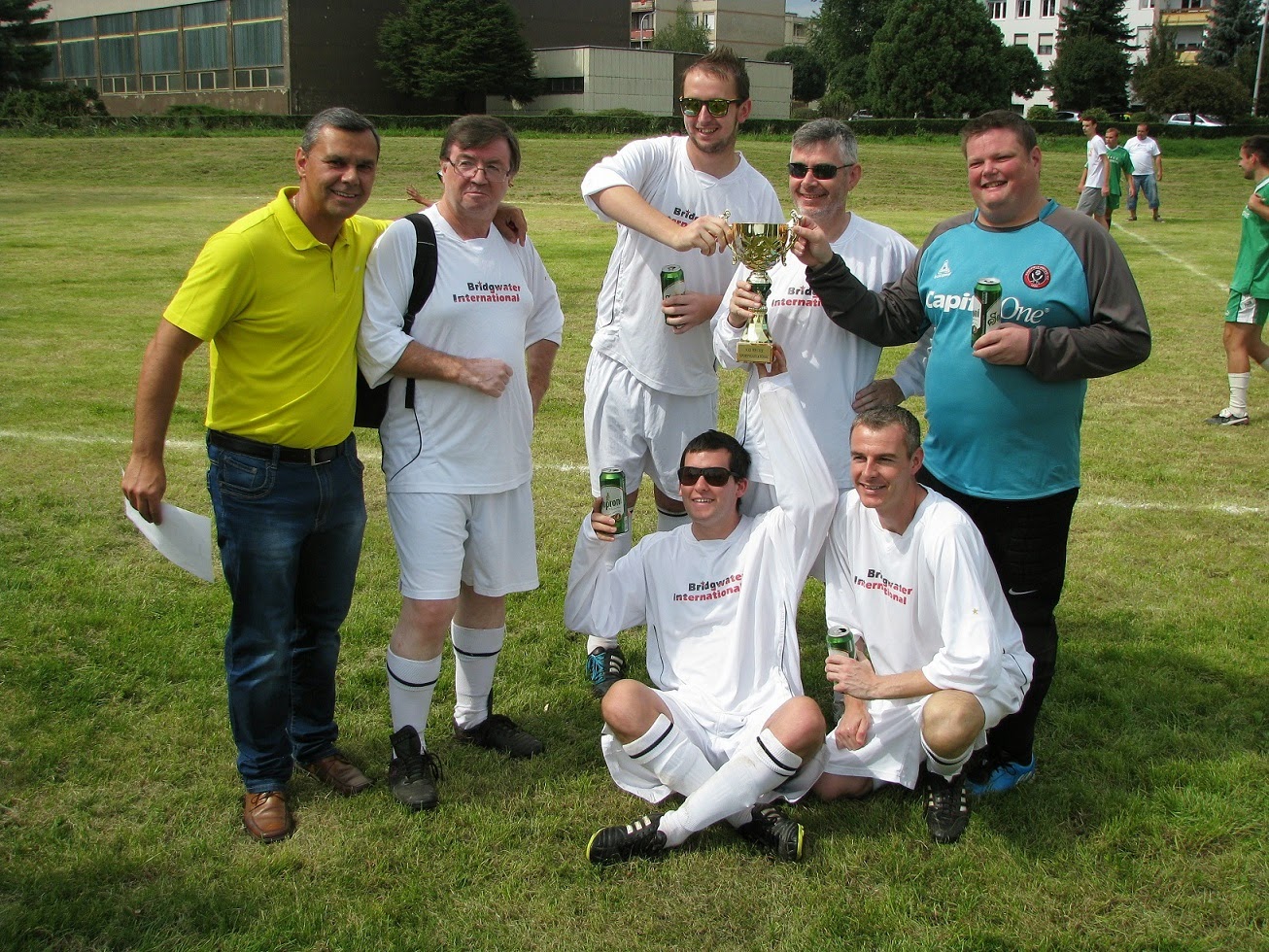
The MSZP went on to deservedly win the trophy (and hopefully the election in October) although the Brits did have a go at showing them how to pose with it before anyone noticed…

The Sarvar project was organised by Zsolt Nemeth and Lajos Szabo and both made speeches of internationalistic goodwill at the social held at the Nadasdy restaurant afterwards. Altech boss Antonin Machala brought 2 barrels of the best Czech beer, Mr Nemeth handed round the Palinka (his home made brandy) and the Hungarian chefs appeared to try to fit 2 entire meals onto each plate
.

Phil takes the ice bucket challenge
The Brits decided to devote much of the tour to drowning themselves in ice cold water. 50% of the group were taking part in the viral ‘ice bucket challenge’ to raise money for charity and Phil, Jamie and Ian all helped add to that mystique of Brits abroad being a bit bonkers by  having people pour icy water onto them in broad daylight in public places. 


When Sarvar was over we tried to find some other places between there and the airport at Vienna. A gigantic Tescos was the first Sunday morning stopover. The sleeping city of Szombately the next. And finally the attractive medieval fortified town of Koszeg  before venturing into the Hapsburg capital itself.


Sarvar, population 16,000, is  officially twinned with Uherske Hradiste and is on Bridgwater’s list for consideration. It’s not as far away as you might think, apart from maybe historically and ideologically, but with a bit of a swing away from the failed ideologies of chauvinistic division and a move into the bright sunny (left-leaning) uplands  it could get a bit closer. 
All friends together